
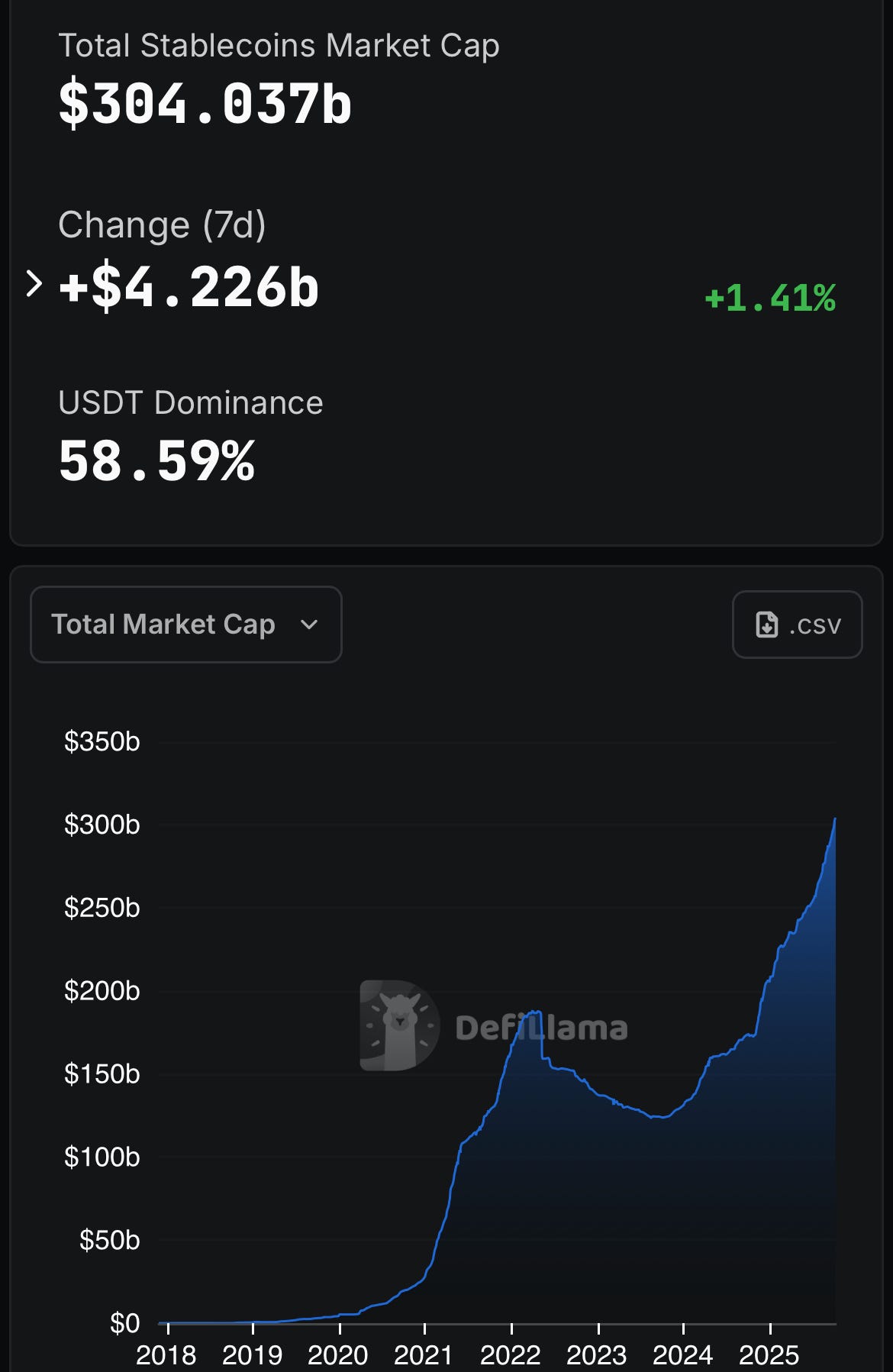
There are over 100 trillion dollars in digital fiat currency circulating worldwide, while approximately 300 billion dollars is held in stablecoins. Stablecoins provide a more efficient method of transacting than traditional digital currency systems, likely driving a significant increase in their circulation and use. As internet-native money, stablecoins settle transactions instantly—similar to sending an email, which does not require hours or days to process. Finally, regulatory clarity is emerging creating a further tailwind for the adoption of this better form of money.
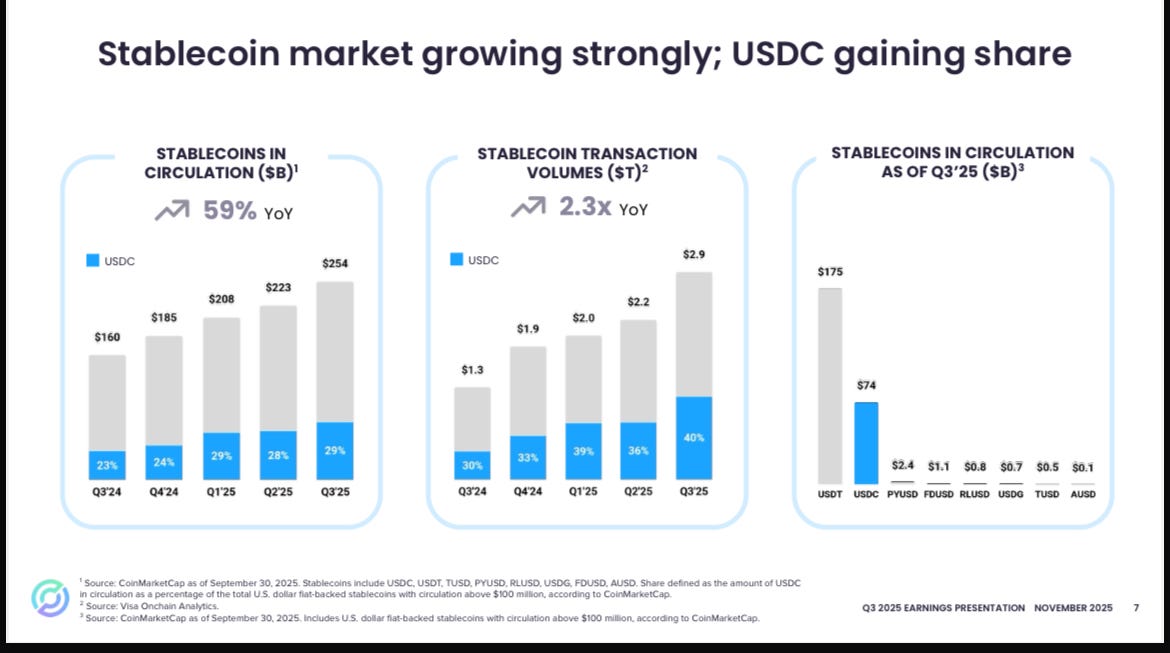
Circle Internet Group issues USDC, the world’s second largest stablecoin, with $74 billion currently in circulation. USDT is the leader, with $175 billion circulating. Notably, USDC’s circulating supply has grown by 105% over the past year, compared to USDT’s 47% growth closing the gap between the two.
Seeing as how less than one percent of the global currency market has been penetrated by this better form of money it’s fair to say that the opportunity here is massive. USDC has many attributes that could ultimately result in it surpassing USDT and becoming the dominant internet native money.
Regulatory Landscape
As stated prior, the regulatory landscape is quickly becoming more favorable to stablecoins, namely the result of new federal measures like the GENIUS Act of 2025. This landmark legislation establishes comprehensive licensing requirements, clearer definitions, and rigorous reserve standards for payment stablecoins, overseen by federal banking regulators. As a result, both institutional and consumer adoption are expected to accelerate as legal barriers recede and stablecoins become safer, more transparent, and credibly backed by high-quality liquid assets.
Stablecoins are also proving to be a powerful strategic tool for strengthening the dollar. Treasury Secretary Scott Bessent stated that ‘Stablecoins represent a revolution in digital finance. The dollar now has an internet-native payment rail that is fast, frictionless, and free of middlemen. This groundbreaking technology will buttress the dollar’s status as the global reserve currency, expand access to the dollar economy for billions across the globe, and lead to a surge in demand for US Treasuries, which back stablecoins. The GENIUS Act, he noted, provides regulatory clarity needed for stablecoins to help the U.S. dollar maintain its global leadership.
Furthering this sentiment Scott Bessent predicted that stablecoins market cap could reach $2 trillion by 2028, given supportive legislation and increasing global demand for digital dollars and payment efficiency. Bessent emphasized that this growth would be driven by adoption in emerging markets, greater institutional use, and the strengthening role of stablecoins as foundational infrastructure for dollar-backed digital payments.
Why Stablecoins are Better
Stablecoins are internet native money. They are cheaper, faster, frictionless more transparent and programmable 24 hours a day 7 days a week. The main impediment for stablecoins has been regulatory uncertainty but is now receding. Even under those headwinds, stablecoins grew rapidly, mainly within crypto-native ecosystems.
Today, the largest real-world (non-crypto-native) use case is cross-border transfers, especially remittances. People and businesses are already using stablecoins to move money instantly and at a fraction of the cost of legacy rails. Compared to wires, remittance services, or SWIFT, stablecoins are a massive upgrade in speed, cost, and accessibility.
Now that regulatory clarity is improving many new verticals are developing where stablecoins are utilized:
For consumers and creators
. Cross border payouts & payroll: real time pay for freelancers, creators, and contractors. Payouts can be more continuous rather than bi-weekly.
. Merchant checkout: e-commerce and in-app pay with auto-FX to local currency; fewer chargebacks.
. Programmable escrow/marketplaces: hold-and-release, split payments, instant royalties.
For Businesses (B2B)
. Supplier payments & invoices: 24/7 settlement, large tickets, automated reconciliation into ERP (SAP/NetSuite).
. Treasury & cash management: same-day sweeping between banks, exchanges, and wallets; intraday liquidity.
. On-chain FX: USD stablecoin ↔ local currency via regulated on/off-ramps; cheaper exotic corridors.
For Finance & Capital Markets
. RWA/tokenization settlement leg: stablecoins as the cash side for T-bills, MMFs, receivables; atomic DvP.
. Credit primitives: invoice factoring, revenue-share contracts, BNPL with instant settlement.
. Compliant privacy & reversibility: selective-disclosure receipts, policy-based freezes/chargeback-like flows.
Public sector & NGOs
. Aid and stipends: targeted disbursements with spend controls; faster reconciliation and auditability.
. Cross-border B2G/G2B payments: fees, permits, vendor pay without SWIFT friction.
New Frontier Use Cases
. AI agents / machine-to-machine: pay-per-API call, per-minute GPU/compute, per-kWh energy.
. Micropayments: paywalls, IoT, media/royalty streaming where card rails don’t work.
Many innovations become possible through stablecoins that traditional digital fiat cannot enable. These examples represent only the known uses so far. As Circle co-founder and CEO Jeremy Allaire highlights, no one predicted that smartphones would transform global transportation by enabling apps like Uber—an unexpected downstream consequence. Similarly, while the full impact of adopting Internet-native money remains unknown, it may soon unlock unforeseen innovations that reshape industries in ways we cannot yet imagine.
Cicle’s Moat Durability
Recently it was rumored that Tether, the issuer of USDT, was in talks to raise $15–20 billion at a $500 billion valuation. This underscores how lucrative the stablecoin‑issuer business has become, and many fintech companies have responded by announcing plans for their own stablecoins. At first glance, this wave of new entrants suggests that competition could intensify and erode incumbents’ economics.
However, stablecoins appear to follow a winner‑takes‑most dynamic, because the token with the deepest liquidity and strongest network effects enjoys a powerful structural advantage. USDC has already built a substantial network and is arguably the world’s most trusted stablecoin. As a result, it is seeing the most traction with adoption from traditional companies such as Visa, Mastercard, and major fintech platforms, further reinforcing its lead and widening its moat over smaller challengers.
USDC is also the most transparent stablecoin, especially when compared with USDT, which has long faced criticism for opaque reserves and limited disclosures. Taking a regulation‑first approach, Circle has built strong regulatory credibility and deep relationships with banks, which enhances USDC’s perceived safety and reliability during periods of market stress.
Circle has also deployed native USDC across a wide range of blockchains, giving it greater interoperability than most competitors. In a world where users and institutions increasingly expect seamless movement of value across chains, this broad multi‑chain footprint is a meaningful and growing advantage.
All of these attributes reinforce one another, creating a powerful flywheel that deepens Circle’s advantages and increases switching costs over time. As this dynamic compounds, the stablecoin market is likely to skew toward a winner‑takes‑most outcome, with Circle positioned as a leading beneficiary becoming embedded into the world’s financial system.
Circle’s Core Revenue Driver
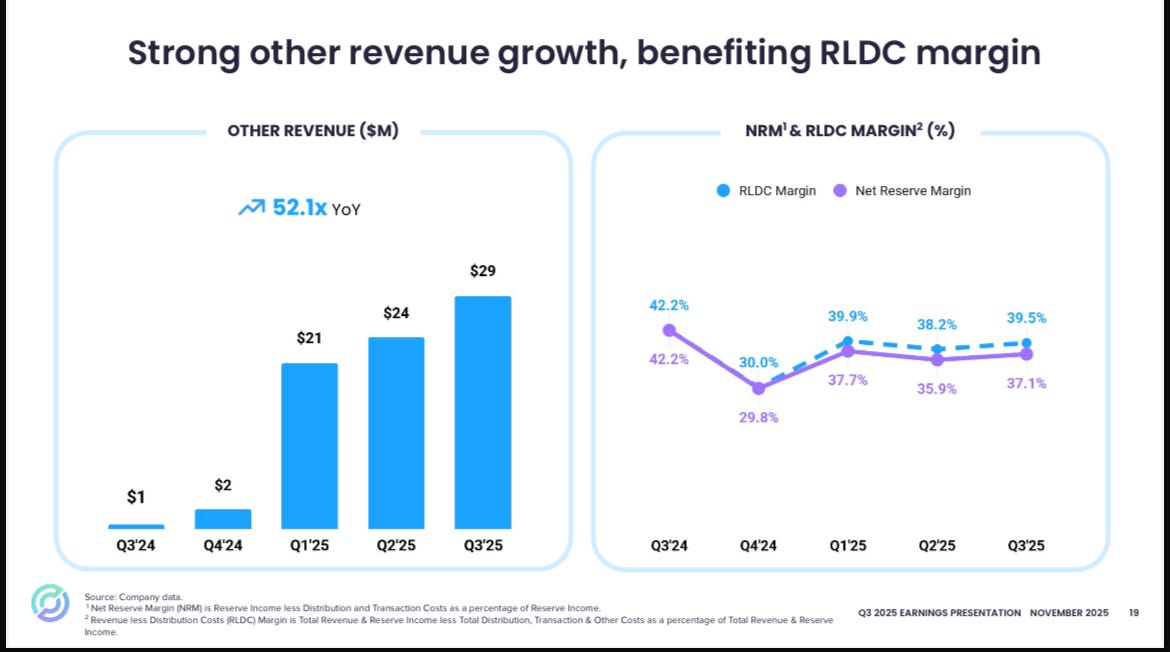
Circle’s revenue mix is still overwhelmingly driven by interest on the reserves backing USDC, with interest income accounting for roughly 96% of total revenue in Q3 2025. Those reserves sit primarily in short‑duration U.S. Treasuries, making Circle’s top line highly sensitive to moves in short‑term rates. Encouragingly, non‑interest revenue is scaling quickly and, if this trajectory continues, should both diversify the business and support structurally higher margins over time; non‑interest income grew by roughly 52x year over year in the same quarter, albeit off a small base.
DCF Valuation
Secretary Bessent’s forecasts stablecoins to reach $3 trillion market cap by 2030 which implies a compounded annual growth rate (CAGR) of ~57%. Against this backdrop, assigning Circle a revenue CAGR of 20% over the next eight years appears very conservative, particularly given the rapid expansion of its non-interest income streams, which carry structurally higher margins. However interest rates lowering are likely to hurt Circles revenue and uncertainty around rates calls for some conservatism.
On profitability, I assume Circle can scale free cash flow margins from roughly ~20% today toward an optimized 32% by year eight as operating leverage improves. Using a 12% discount rate and 3% terminal growth, this framework implies an equity value of roughly $96 per share (on ~234M total shares). With the stock trading around $86, the base case implies roughly ~12% upside.
Conclusion
Circle is poised to be a major beneficiary of stablecoin adoption and is well positioned to remain a market leader. Stablecoins are a fundamentally new financial technology, and their long‑term impact is difficult to forecast, just as the path of interest rates—which heavily influence Circle’s results—remains highly uncertain. Even under a conservative DCF framework, the stock screens as modestly undervalued, and the upside could be substantial if Circle can sustain growth meaningfully above 20% over the coming years, which appears entirely plausible given current trends.